
Employment Insurance (EI) benefits

Reviewed: March 2026
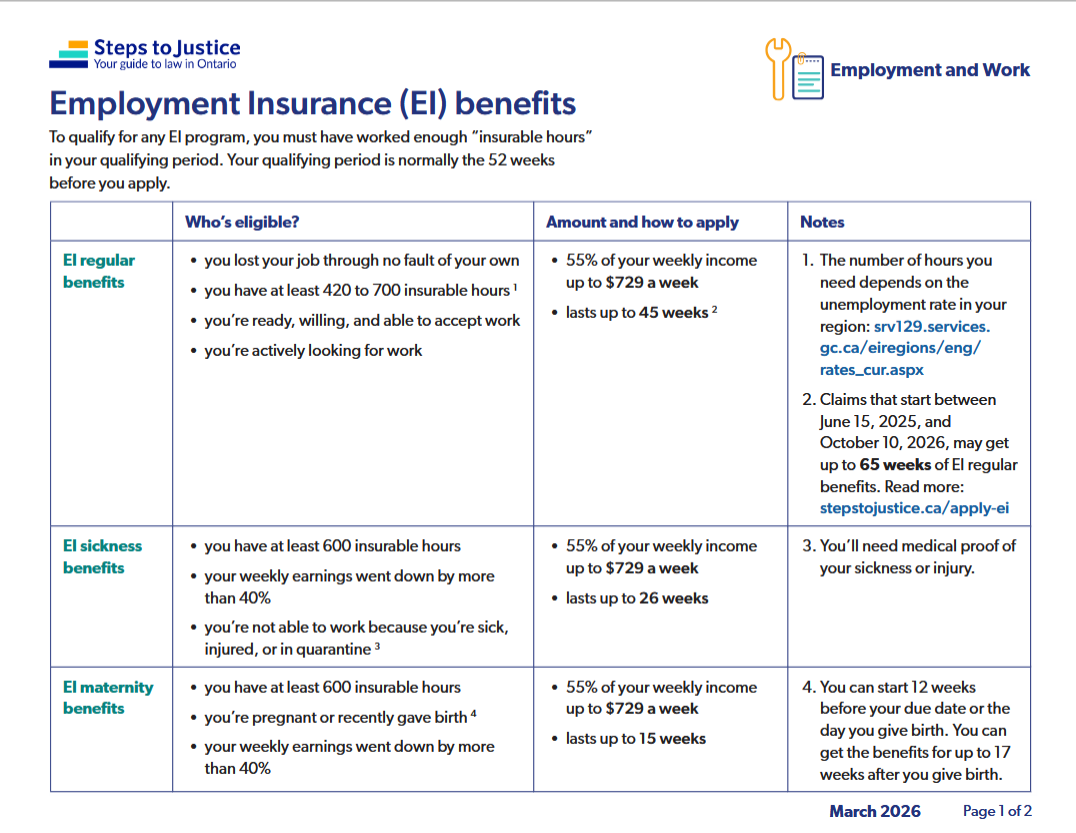
To qualify for any EI program, you must have worked enough “insurable hours” in your qualifying period. Your qualifying period is normally the 52 weeks before you apply.
| Who’s eligible | Amount and how to apply | Notes | |
| EI regular benefits |
|
|
1. The number of hours you need depends on the unemployment rate in your region: srv129.services.gc.ca/eiregions/eng/rates_cur.aspx 2. Claims that start between June 15, 2025 and October 10, 2026 may get up to 65 weeks of EI regular benefits. Read more: stepstojustice.ca/apply-ei |
| EI sickness benefits |
|
|
3. You’ll need medical proof of your sickness or injury. |
| EI maternity benefits |
|
|
4. You can start 12 weeks before your due date or the day you give birth. You can get the benefits for up to 17 weeks after you give birth. |
| EI parental benefits |
|
Standard benefits (35 weeks):
Extended benefits (61 weeks):
|
5. You must use the standard leave within 52 weeks of your child’s birth or adoption, or within 78 weeks if you take an extended leave. |
| EI caregiving benefits |
|
|
6. A doctor or nurse practitioner must certify that the person is critically ill or injured, or needs end-of-life care. |
Reviewed: March 2026
For more on EI, visit stepstojustice.ca/emp-ins. This is general information for people in Ontario, Canada. It’s not legal advice.
For more details, read Employment Insurance at cleo.on.ca/EI.