I lost my job for reasons beyond my control. Can I get EI?
- do not have to wait one week to get your first payment
- can get EI benefits and separation earnings, such as termination, severance, and vacation pay, at the same time
For claims that start between June 15, 2025, and June 12, 2027, you may also get an extra 20 weeks, up to a maximum of 65 weeks, of EI regular benefits if you:
- got at least one week of regular benefits
- got fewer than 36 weeks of EI regular or fishing benefits in the 3 years before your claim starts
- paid at least 30% of the annual maximum EI premiums for at least 7 of the 10 years before your claim starts
There's a new temporary measure for claims that start between October 11, 2026, and October 9, 2027, if you left your most recent job through no fault of your own. You can get EI payments based on any hours and earnings from all during your .
Read more about temporary EI measures.
Employment Insurance (EI) benefits provide some short-term financial help for people who are out of work. Most jobs in Canada take money from your paycheque to pay into the EI program. Even if your employer hasn't paid into the program, you might still be able to get EI.
If you apply more than 4 weeks after you have an , it may be harder to get approved for EI. If you are approved, you might get less money. This is because there will be a large period of time where you have no hours worked and no money earned.
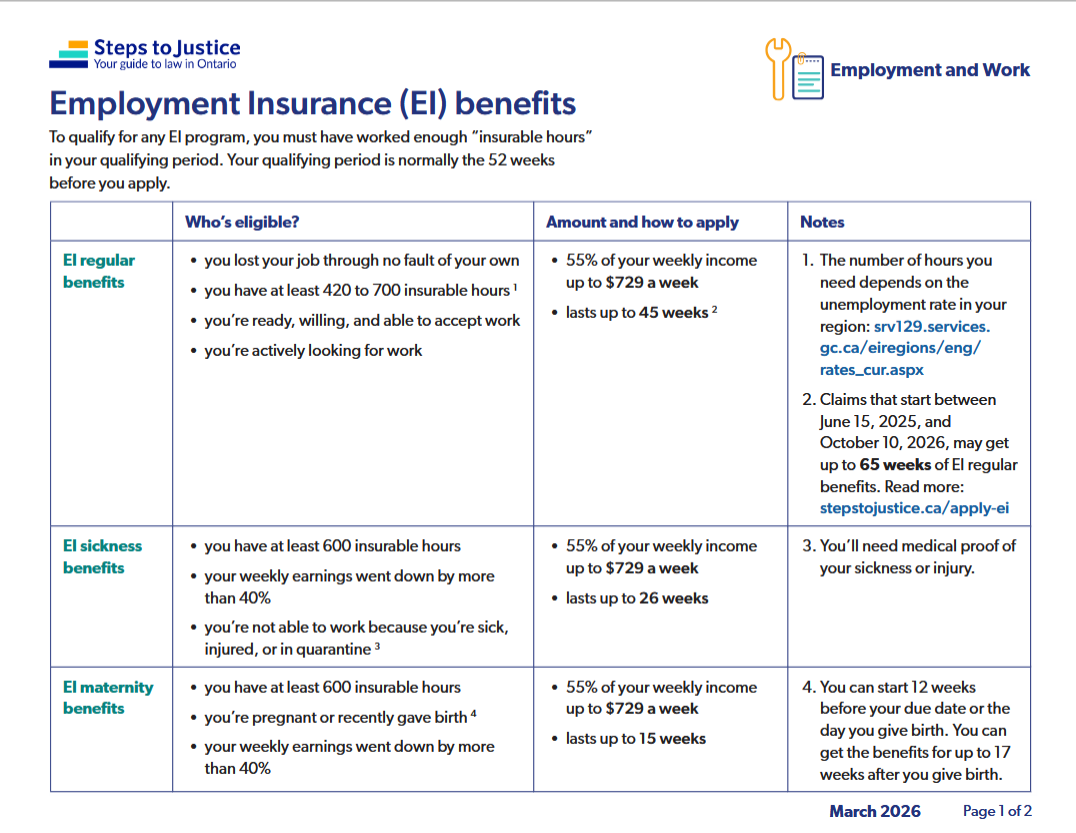
There are different EI benefits that might be available for your situation. These are:
- Sickness benefits: if you are unable to work because of illness, injury, or quarantine.
- Maternity benefits: if you are pregnant or have recently had a baby.
- Parental benefits: if you are a parent and are caring for a new born child or a child you recently adopted.
- Compassionate care benefits: if you need time off work to provide care or support to a family member who could die in the next six months.
- The family caregiver benefit for children: if you need time off work to provide care or support to your critically ill child.
- Fishing benefits: if you are a self-employed fisher actively looking for work.
You might be able to get EI regular benefits if you:
- were employed in insurable employment
- lost your job through no fault of your own
- have not worked or been paid for at least 7 days
- worked enough hours to qualify for EI, usually in the last 52 weeks
You must also be ready and able to work right away, and actively looking for work.
You might not be able to get EI regular benefits if you:
- quit your job when you had other reasonable choices to keep working
- were fired for misconduct
- are self-employed
- are unemployed because you are participating in a labour dispute, like a strike or lockout