
2. Move out and protect your right to move back in
Question and answer
Can my landlord make me move out for repairs or renovations?You might decide you want to move out either permanently or just until the work is finished.
If so, you do not have to wait until the in the Form N13 your landlord gave you.
But you must give at least 10 days' written notice to your landlord.
Protect your right to move back in later
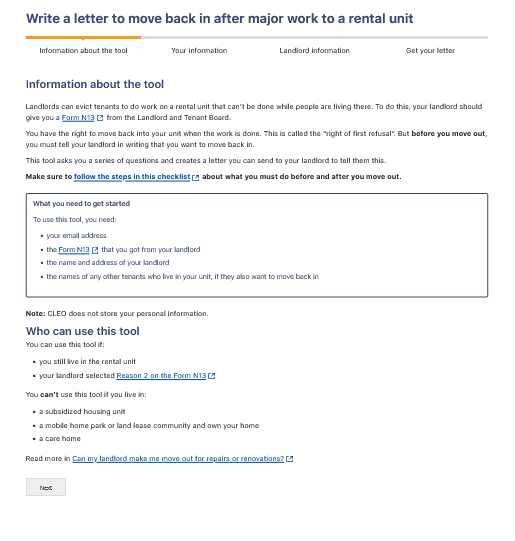
If you decide to move out, you have the right to move back into your unit once the work is finished. This is sometimes called the “right of first refusal”.
To have this right of first refusal, you must tell the landlord in writing before you move out that you want to move back in when the work is done. You must also give your landlord your new address in writing and any change of address after that. It's a good idea to send these documents by registered mail. You should keep the mail receipt and a copy of the documents for yourself. This will help if you need to prove that you did it.
You do not pay rent to your landlord while you are away. You only need to start paying them rent again when you move back in after the work is done.
And if you choose to move back in, your landlord cannot charge you a higher rent than they could if you had stayed.

Written notices of completion date
If you asked for a right of first refusal, your landlord must give you written notices of:
- the estimated completion date,
- any changes to the estimated completion date, and
- the ready date for moving back into the rental unit.
Your landlord must also give you 60 days after the ready date to move back in.
If your landlord does not let you back in
Sometimes landlords do not respect your right to move back in. They might decide to rent the place to someone else, usually at a much higher rent.
If your landlord does not follow the rules or let you back in, you might be able to get compensation by applying to the (LTB).
Timelines for remedies
You can apply to the LTB for your landlord's “failure to afford a right of first refusal”.
To do this, you fill in Form T5: Landlord Gave a Notice of Termination in Bad Faith and send it to the LTB:
- within 2 years from your move-out date, or
- within 6 months from the completion date of the repairs or renovations
Remedies
The LTB can the landlord to pay:
- your moving and storage costs
- a fine to the LTB
- a rent abatement, which means your landlord gives you back some of the rent you paid
- money equal to no more than your previous 12 months' rent, for the pain and suffering of being forced out of your home unlawfully
If the rent is higher at your new place, the LTB can also order the landlord to pay the difference in rent for up to one year.
And if the place has not yet been rented to someone else, the LTB can order your landlord to let you move back in.
Try to keep your place
If a new tenant has already moved in, the LTB probably will not order the landlord to let you back into your place. So if keeping your place is important to you, it's best to make sure the landlord does not rent it to someone else.
This can be hard to do. But there are some things you can try:
- You could go back to the place often to see when the repairs are completed.
- Look for any signs that your landlord is planning to rent your place to someone else.
- You can ask your neighbours to let you know if they notice anything. For example, they might see a For Rent sign, or the landlord showing the unit.
- You can also check to see if your place is being advertised for rent. You might have to check in different places, including online sites like Facebook Marketplace, Kijiji, Airbnb, and others.
If you find that the landlord might be planning to rent your place to someone else, you need to act quickly to stop them from getting a new tenant.
You should try to get legal help.